Denali National Park Hiking Guide

Welcome to the Denali National Park Hiking Guide
Here you will find information on hiking trails for day hikes and backcountry exploration, biking paths, and wilderness areas of interest for hikers.

-SPONSORED LINKS-
Denali National Park Lodging
Denali National Park Maps
Denali National Park Hotels
Denali National Park Camping
Denali National Park Photos
Denali National Park Tours 
Denali National Park Cabins
Sow and Cubs - Corel ©

Sponsored National Park Search

Denali National Park Hiking Guide

  • Bear Safety Precautions
  • Backcountry Hiking
  • Hiking Guide
  • Mountaineering
  • Leave No Trace
  • Where to Hike
  • 
    

    Hiking Information

    Denali is predominately a trailless park. Hikers must travel cross-country. Be prepared for uneven terrain and possibly streams and brush. There is a trail system in the park entrance area.

    Many rewards await those who take the challenge of hiking without a trail in the backcountry of Denali: spectacular vistas, possible encounters with wildlife, and the experience of traveling the land much as the first explorers did. Be sure to carry the proper gear and be familiar with potential hazards and bear safety precautions. Ranger led Discovery Hikes provide an excellent introduction to backcountry day hiking in Denali. Sign up for Discovery Hikes at the Visitor Center.

    Discovery Hike

    Moderate to moderately strenuous 3 to 4 hour hikes in the backcountry wilderness of Denali. Expect uneven terrain, no trails and small stream crossings. Hikers must wear sturdy hiking boots and carry rain gear, food, and water. Locations change daily and their descriptions are posted at the Visitor Center (VC). Sign-up is required 1 to 2 days in advance at the main VC.

    Short guided hikes depart daily from the back porch of the Denali Park Hotel and from Eielson Visitor Center. Explore taiga and tundra on these 30 to 90 minute walks. Begins mid-June. Check at the visitor center for information and schedule.

    Hiking Trails
    Trail Trailhead Difficulty Length Elev Chg Time
    Horseshoe Lake Begins at mile 0.9 on the park road near the railroad track crossing. Self-guided pamphlet at trailhead Moderate 1.5 miles roundtrip 200 feet 1 hour roundtrip
    Morino Loop Begins/ends at the Denali Park Hotel parking lot Easy 1.3 mile loop 100 feet 1 hour roundtrip
    Mount Healy Begins and ends at the Denali Park Hotel parking lot. Take the Taiga Loop trail for .3 miles and look for the Mount Healy trailhead after crossing the second service road. Note, a moderate portion of this hike ends at the benches at mile 2 Strenuous 5.0 miles roundtrip 1,700 feet 3 - 4 hours roundtrip
    Roadside Connects the Denali Park Hotel to Park Headquarters. Note, this trail also extends from the Hotel to the visitor center Moderate 1.8 miles one way 300 feet 1 hour one way
    Rock Creek Connects the Denali Park Hotel to Park Headquarters Moderate 2.3 miles one way 400 feet 2 hours one way uphill
    Taiga Loop Begins/ends at the Denali Park Hotel parking lot Easy 1.3 mile loop 150 feet 1 hour roundtrip


    Backcountry Hiking Information

    Years ago a conscious decision was made not to develop trails in Denali. Wilderness in Alaska by its very nature should be trailless, providing a contrast to other wilderness units elsewhere. Realizing trails become travel corridors that bring hikers and concentrate their impacts, having no trails helps us to disperse use and lessen impacts on the landscape.

    Overnight stays in the backcountry of Denali National Park require a free backcountry permit. Permits are available at the Visitor Center during the summer months and at Headquarters during the winter months. Permits are issued only one day in advance; reservations are not accepted.

    All areas require the use of Bear Resistant Food Containers (BRFCs) distributed free of charge with your backcountry permit. Please return your container(s) promptly at the end of your trip. To purchase your own container, stop by the Visitor Center bookstore.


    How to Obtain Backcountry Permit

    Watch Backcountry Simulator program which describes minimum impact camping, wildlife ethics, river crossing, bear safety and backcountry safety and emergencies.

    Check Quota Board on the wall behind the Backcountry Desk for unit availability. Denali's backcountry is divided into 43 units; only a limited number of backpackers are allowed per night in most units. During peak season, many units may be full for several days, and other units may be closed due to wildlife activity. Large hiking groups should be prepared to split up and go into different units.

    Read Backcountry Description Guides which are located at the Backcountry Desk. The Backcountry Companion, for sale at the bookstore in the Visitor Center, is also recommended reading. Please read through one or both of these references before choosing a unit.

    Consult a topographic map while planning your route through the backcountry. Keep in mind the immense scale of this trailless country where even a 5 mile hike can mean an exhausting day. Map reading skills are essential and invaluable.

    Obtain a permit at the Backcountry Desk and reserve a seat on a camper bus. Finalize your plans with the backcountry staff when obtaining your permit. Rangers can help you with your initial planning, but in the end, the success of your trip rests with you. Consult the backcountry gear list.


    Backcountry Gear List
    Packing Tip Pack clothes, sleeping bag, and emergency gear in plastic bag to protect them during rainstorms and river crossings.
    Bear Resistant Food Container For storage of all food and trash
    Food Large daily portions plus several days of emergency rations are recommended. Double layers of plastic bags reduce food/garbage odors that attract bear. Avoid scented, spiced, or smoked foods, such as bacon or tuna fish. Leave behind odorous, non-food items
    Water Please Note: Giardia, a waterborne cyst which causes severe intestinal illness, occurs in the park. Boil all water, or use an approved filter of one micron or less.
    Stove, Fuel, Cooking Gear Campfires are not permitted in the Denali wilderness. White gas is available at the McKinley Mercantile, adjacent to the post office
    Boot and Socks Wear sturdy hiking boots, take extra socks. Extras include neoprene socks and gaiters to keep feet dry; a pair of comfortable soft-soled shoes to minimize impact at campsite.
    Clothing Prepare for cool, wet and windy weather. Dress in layers. Wool, pile or other non-absorbent synthetic insulation is preferable to cotton or down. Hat and gloves are advisable.
    Raingear Rain parkas and pants, or chaps over lightweight wool or polypropylene clothing are effective combinations. Weather is unpredictable and changes quickly.
    Sleeping Bag and Pad For any overnight summer trip, protection to 20° F is suggested. This is the time for a "good" bag and pad for cold weather camping.
    Tent Your shelter should have a waterproof floor, rain fly, and protection from mosquitoes.
    Insect Repellent and/or Head Net Heavy duty protection from mosquitoes and other biting insects.
    Toilet Paper and Trowel Dig a small latrine hole up to six inches deep and at least 100 yards from the nearest water. Cover waste with soil and vegetation; pack out all toilet paper, and used sanitary supplies. Double wrap in plastic.
    Map and Compass Topographic maps are available at the park visitor center bookstores.
    Emergency Gear Bring waterproof matches or lighter, first aid kit, knife, and a signaling device such as a whistle, light or flare.


    Where to hike

    To help choose a location to hike read the following information about the different habitats found within the park. You may want to base your decision on where to hike on what type of terrain you want to hike in. The most common types of terrain in the park are taiga, tundra and gravel bar.


    Taiga

    The taiga forest, found in the lower elevation areas, consists of primarily spruce trees, willow and other brush. This dense cover may impede hiking, but the struggle is often worth it for the vistas possible when you break through to the higher tundra areas. The frontcountry of Denali offers trails through the taiga forest making it easier to travel in this scenic area. The taiga forest is home to many different plants and animals including moose, bear, red squirrels, woodpeckers, and many varieties of berries.


    Tundra

    There are two types of tundra areas in Denali, found when climbing above the taiga forest, moist tundra and dry tundra..

    Moist tundra, has a ground cover of sponge-like mosses and small brush. Hiking in this habitat offers opportunities for viewing caribou, fox and bear amongst the wildflowers and berries.

    Dry tundra is found in the higher alpine areas, interspersed with scree (small loose rocks). It is home to spectacular wildflowers. Animals such as the Dall Sheep, Caribou and Arctic Ground Squirrel, thrive in this seemingly barren ecosystem.


    Gravel River Bars

    A great way to take a moderate hike with good visibility is to walk along the wide gravel bars of Denali's braided rivers. It is possible to see impressive animal tracks, many varieties of wildflowers and wildlife as they travel this relatively easy route.


    River Crossings

    Just as Denali has few trails, there are few bridges in the backcountry of Denali. Stream and river crossings should be made with caution. The water is very cold from spring and summer snow melt and the rivers are swift and deep. Bring additional clothing and boots to change into.


    Bear Safety Precautions

    Denali National Park and Preserve is home to both black bears and grizzly bears. Black bears inhabit the forested areas of the park and are rarely encountered. Grizzly bears live mainly on the open tundra. Most bears seen by visitors along the park road are grizzlies, or brown bears.

    The bears of Denali are wild creatures, free to behave as they wish. If annoyed, these solitary animals can be very dangerous to intruders. For your own protection, as well as to keep the Denali bears healthy and wild, please carefully read and abide by the following rules:

    Be alert at all times, in all places. Bears are active both day and night and can be found anywhere. Watch for their tracks and scat.

    Avoid surprising bears. They may perceive you as a threat if you startle them. Sing, shout, or make other loud noises as you walk to warn bears of your presence. Be especially careful in dense brush, where visibility is low, and along rivers, where bears cannot hear you over the noise of the water.

    Never intentionally approach a bear. Bears should live as free from human interference as possible, so give them space. It is illegal to approach within .25 mile / 0.4 km of a bear.

    Be Bear Aware

    Avoid surprising animals at close range. Whistle, talk, sing, or otherwise make noise when hiking in areas where visibility is limited or bear sign present. Take no pets; they are prohibited in the backcountry. A dog's valor may turn into retreat bringing an infuriated bear to you.

    Be alert to sign (droppings, diggings, fresh tracks, etc.), sounds, or other indications of bears. Be particularly wary when hiking wildlife trails, salmon streams, or other areas where bears concentrate.

    Food and beverages should never be left unattended. Foodstuffs with strong odors such as fish, cheese, sausage, and fresh meats should be stored in a food cache, a bear resistant container, or suspended 10 feet above ground. Carry all refuse and garbage out! Buried refuse will attract bears.

    Keep packs and other personal gear on your person. It is easy to become separated from belongings left lying on the ground when a bear unexpectedly approaches. Bears will investigate, often destructively.

    Bears approach anglers because they have learned to recognize them as a source of food. Stop fishing when bears are present.

    If you keep a fish, you should remove the fish immediately to a proper food storage area.

    Do not approach bears

    The minimum safe distance from any bear is 50 yards; from a sow with young it is 100 yards. These are MINIMUM distances, there are many times that greater distances are required!

    Regardless of precautions taken, you may come across a bear. Usually they will run away. A bear standing on hind legs may only be trying to sense you better, not preparing to attack. Even a charge is often a bluff, ending abruptly short of physical contact.

    If you see a bear at a distance, turn around or make a wide detour. Keep upwind if possible so the bear will get your scent and know you're there. Talk in an assured tone to communicate your presence. Treat animals as if cubs are nearby. Assume the bear will be defensive. Do not approach closer to scare a bear away as you may be considered a threat.

    Avoid actions that interfere with bear movement or foraging activities.

    Be satisfied with a distant photograph, or use a telephoto lense. Many fatalities and injuries have been related to photography.

    Do not corner an animal. Allow them plenty of space and an escape route.

    Bears are typically solitary animals. Much of their communication at feeding aggregations, such as occur on Brooks River, serves to maintain spacing and avoid conflict. Bears appear to have only a limited repertoire for this purpose. These behavior patterns are not highly ritualized, as in some species; therefore, their meaning is largely dependent on the context of the situation.

    Descriptions of some behavior and a general interpretation of meaning follow to help you understand what a bear may be trying to tell you. Remember, each bear is an individual and each encounter is unique.

    Postures

    Standing on hind legs - A bear standing bipedally is typically not expressing aggression. Bears generally stand on their hind legs to gain more information, both olfactory and visual.

    Stationary lateral body orientation - A bear may stand broadside to assert itself in some instances. In encounters with human, it has usually been interpreted as a demonstration of size.

    Stationary frontal orientation - If a bear is standing and facing you, it is certainly not being submissive. This is an aggressive position and may signal a charge. It is likely waiting for you to withdraw.

    Vocalizations

    Huffing - When a bear is tense, it may forcibly exhale a series of several sharp, rasping huffs. A mother may also huff in order to gain the attention of her young.

    Woof - A startled bear may emit a single sharp exhale that lakes the harsh quality of a huff. If her cubs woof, a mother will immediately become alert to the situation.

    Jaw-Popping - Females with young often emit a throaty popping sound, apparently to beckon their cubs when danger is sensed. A mother vocalizing in this manner should be considered nervous and extremely stressed. Bears other than sows also jaw-pop.

    Growl, snarl, roar - Clear indication of intolerance.

    Other Indicators

    Yawning - Indicates tension. This behavior may results from the close proximity of another bear or human presence.

    Excessive Salivation - A clear sign of tension, salivation may appear as white foam around the bear's mouth.

    The Charge

    The vast majority of charges are ones in which the bear stops before making contact. The intensity of the charge or associated vocalizations may vary, but it is distinct in that it is an aggressive or defensive act clearly directed at another bear or human. Bears may charge immediately, as a sow fearing for her cubs, or may emit stressed or erratic behavior before charging.

    There is no guaranteed lifesaving method of reacting to an aggressive bear. Some behavior patterns have proven more successful in close encounters than others. Take a calm assured posture. A firm voice and gradual departure are better than a retreat in panic. Include the nature of your surroundings in your reaction.

    As a last resort, lie face down, protect your neck with your hands and arms, and don't move. This requires considerable courage, but resistance would be futile. Numerous incidents exist where a bear has sniffed and departed without serious injury.


    Leave No Trace

    Denali may seem rugged, but it is also fragile. The goal is to have minimum human impact. To help preserve it, follow low-impact camping practices wherever you go.

    Plan ahead and prepare

    Travel and camp on durable surfaces In popular areas: In pristine areas: Dispose of Waste Properly Leave What You Find Minimize Campfire Impacts Respect Wildlife Be Considerate of Other Visitors


    Mountaineering

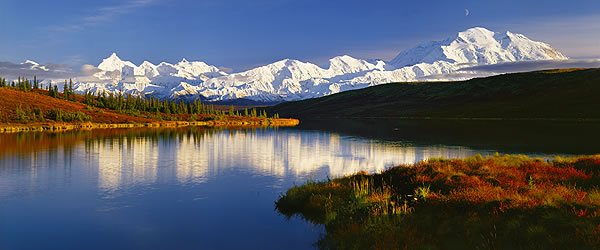
    Mount McKinley has been called the Alaskan landscape's most impressive feature. While you may not see this great peak during your stay here, it is there! Mount McKinley is the highest mountain on the North American continent. Measured from the 2,000-foot lowlands near Wonder Lakes to its summit, this mountain is considered to be the highest in the world. The vertical relief of 18,000 feet, greater even than that of Mount Everest, tops out on the snowy summit at 20,320 feet. McKinley's north summit is North America's second highest peak at 19,470 feet. Temperatures at the summit are severe even in the summer. Winter lows at just 14,500 feet can plummet below -95° F! During storms, winds can gust to more than 150 mph. Permanent snowfields cover more than 50 percent of the mountain and feed the many glaciers that surround its base. The mountain's granite and slate core is, in fact overlain by ice that is hundreds of feet thick in places.

    Mount McKinley reigns in lofty isolation over the Alaska Range, that magnificent 600 mile arc of mountains that divide south-central Alaska from the interior plateau. Its life as a mountain range began some 65 million years ago, the result of the Denali Fault, north America's largest crustal break. This fault, where two tectonic plates have moved against each other, stretches for 1,300 miles from the Yukon border down to the Aleutian peninsula. There the Alaska and Aleutian Ranges meet in a mad jumble of peaks that include active volcanoes. Earthquakes tremors both mild and moderate are frequent occurrences in the park and preserve.

    Though Mt. McKinley can be seen from Anchorage on a clear day, its base is deep in the Alaska Range. Early 1900 explorers used river boats, mules and dog sleds to gain access to the mountain's glaciers in order to establish base camps.

    Beginning in 1932 plane access to climb Mt. McKinley began saving the mountaineers a few months travel time. That same year, bush pilot Joe Crosson set the "Cosmic Ray" Party down at the 5,700-foot level of the Muldrow Glacier. Coincidentally, two members of this party became the mountain's first fatalities during the descent.

    Twenty-two years later, in 1954, pilot Don Sheldon flew the first commercial flight from Talkeetna to Kahiltna Glacier which has become the norm for most McKinley climbers beginning their expeditions.

    The building of these massive mountains began out of flat lowland. The material that Earth's inner turmoil thrust up has subsequently been eroded, sculpted, and weighed down by huge masses of ice. Numerous glaciers still radiate from the high peaks of the Alaska Range, where the frigid temperatures prevent them from melting. Some of the glaciers are visible from the park roads. The debris-laden snout of the 35-mile-long Muldrow glacier lies within a half mile of the park road. The park and preserve owes its beautiful landscape contrasts - wide, low plains and dark, somber mountains; brightly colored peaks and sheer granite domes - to the Denali Fault. Geologists say that Mount McKinley still rises today.

    While McKinley is a great mountain, there are many other interesting mountain peaks to view in the park which include but are not limited to Foraker, Mather, Hunter and Cathedral Spires.

    Climbers on Mount McKinley and Mount Foraker are charged a special use fee of $150.00 per climber. This offsets costs related to rescues such as maintaining the high altitude ranger station, staff and helicopter. In addition to the special use fee, a 60 day pre-registration regulation allows mountaineering rangers to have direct contact with climbers before they arrive in Talkeetna. In doing so, rangers are able to suggest appropriate routes for different levels of expertise and offer first hand knowledge of conditions encountered in the Alaska Range.

    The National Park Service wishes to notify climbers and mountaineers that they should expect that these regulations are strictly enforced. Climbers who are not pre-registered a minimum of 60 days in advance will be denied permission to climb Mount McKinley or Mount Foraker.

    For information write to Talkeetma Ranger Station, Box 588, Talkeetna, AK 99676 or call: 907-733-2231.


    Denali National Park Travel Packets

    Denali National Park Links
    Bullet Activity & Calendar Page
    Bullet Address, Email & Phone Guide
    Bullet Backcountry Camping
    Bullet Backcountry Hiking
    Bullet Bear Safety Precautions
    Bullet Biking
    Bullet Brochures, Maps, Written Info
    Bullet Camper Bus
    Bullet Camping Guide
    Bullet Establishment
    Bullet Fees
    Bullet Fishing Guide
    Bullet Group Campgrounds
    Bullet Hiking Guide
    Bullet Jobs, SCA, Volunteer Positions
    Bullet Land Use Guide
    Bullet Leave No Trace
    Bullet Location
    Bullet Lodging Guide
    Bullet Map Guide
    Bullet Mountaineering
    Bullet Park Information
    Bullet Pet Information
    Bullet Road Lottery
    Bullet Search
    Bullet Shuttle Bus Information
    Bullet Sights Guide
    Bullet Size Information
    Bullet Travel Guide
    Bullet Visitors Guide
    Bullet Weather
    Bullet Wildlife of Taiga & Tundra

    Alaska State Information Page

    Denali National Park
    Alaska National Parks
    Back to National Parks


    by John William Uhler

    Copyright © 1995 - 2007 Hillclimb Media

    This site is in no way associated with the United States Government, the Department of the Interior or the National Park Service

    Demand Media Knowledge